2026-07-07 / Journal
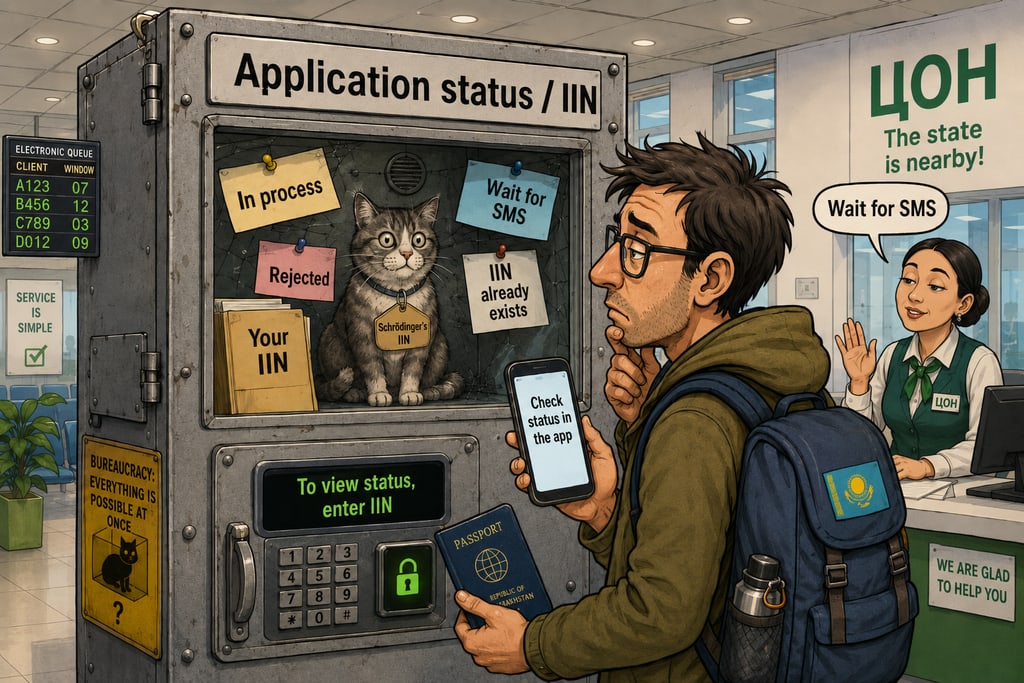
Schrödinger's IIN: How My Kazakhstan Plan Went Sideways
How getting a Kazakhstan IIN turned into a week of quantum bureaucracy: a system outage, a reasonless rejection, and a sudden "you already have one".
In the second part of this series, I wrote that in 99 percent of online stories the IIN arrives the next day after application — and that mine did not, “but that is a separate article.” This is that article.
A quick recap for those who start here: the IIN is Kazakhstan’s Individual Identification Number, a registry entry without which no local bank will open an account for you. It is issued through a public service center called a TsON.
Spoiler: I had planned about three days for the whole banking setup, and the IIN story alone took a week and a half. I had deliberately not bought a return ticket — which, as it turned out, was the right call.
One note for those who were better friends with literature than with physics at school, or who never watched The Big Bang Theory. The physicist Schrödinger came up with a thought experiment: a cat sits in a closed box and, until the box is opened, counts as both alive and dead at the same time. It sounds like mockery of common sense and of the cat, but I have not found a better description of my IIN application. There will be almost no more physics in this text.
And the usual disclaimer: this is personal experience from early May 2026. The rules of public service centers, banks, and government services can change quickly and without warning, and this text is not legal advice. The cause of what happened was never officially explained to me, so every theory in this text is exactly that — a theory, and I mark them as such.
Monday: The Application And The First Paradox
On the morning of May 4, somewhere between nine and half past ten, I came to the TsON of the Almaly district in Almaty and applied for an IIN. Everything went by the book: the application was accepted, and soon an SMS arrived — application registered, status can be tracked in the history section of the TsON app.
Then came the first paradox. To log into the app, you need a phone number and an IIN. The IIN is exactly the thing I was waiting for. In other words, the window for observing the application opens with a key that is locked inside the application itself. The box with the cat snapped shut.
I was not given an application number at submission. At the time I thought nothing of it — and that was a mistake: this piece of paper would turn out to be the main measuring instrument of the whole story.
Also, it was precisely on May 4, as I would learn later, that the system had an outage. But I would only find that out days later.
Three Days Of Superposition
From Tuesday on, my application lived in all states at once: accepted, in processing, not moving — depending on who was looking at it and how.
On Tuesday I went back to the same TsON. “Wait for the SMS.” I called the 1414 government services hotline — you have to fight your way through a bot to reach a live operator, though you can at least pick your language. “Wait for the SMS.” And the support line can only look up an application’s status by its number — which I did not have, see Monday. The circle closed for the second time.
On Wednesday, the TsON said the application was “still in processing,” and context started surfacing: there had been a system outage on May 4. The application, according to the staff, did exist in the system. Whether it was alive, nobody would say — but nobody was rushing to bury it either.
Thursday, May 7, was a public holiday, and time simply stopped. That was the day, with still no results, when I first clearly understood: something is wrong here. And I started thinking about a backup move — visiting another TsON that was rumored to be friendlier to foreigners.
Friday: Two Service Centers And One Printout
On the morning of May 8, I went to the migration TsON in the Turksib district, near Richard Sorge Street — a place that sees more migration cases and foreigners. They would not touch my application: “The status is checked at the center where you submitted your documents.” A U-turn, and back to the Almaly TsON.
And there, at last, they admitted it: the application had not moved because of the outage. They suggested applying again. I did — but this time I asked for the application number.
“We don’t issue those.”
I insisted: this number is what the phone support asks for, it is what the TsON itself asks for, and without it there is no way to check the status. The operator sighed heavily, repeated that they do not normally do this — and printed me the application page: the number, my details, the details of the receiving operator. A small victory of the observer over the box.
4:25 PM: Rejection Without A Reason
At 4:25 PM that same day, an SMS arrived: application rejected. No reason given. There was no time left to get to the TsON and find out why.
Then the calendar played against me. May 9 — Victory Day, a public holiday — fell on a Saturday, so Monday the 11th became a day off in lieu. Three days with nobody to ask. The night from Friday to Saturday was my last in the hotel I had paid for, so the decision could not wait: keep waiting in Almaty, extend the accommodation, find a new one — or leave for Kyrgyzstan, which had been listed as the backup option from the start.
If there was a moment of quiet internal panic in this story, this was it.
Shashlik And The Spy Theory
That evening I went out for shashlik — skewers of grilled meat, a genre taken very seriously in this part of the world. The places had been recommended to me earlier by Sasha, a local tango dancer from the milonga (a social tango night — one of the reasons I picked Almaty in the first place): “Dato” and “Venetsia.” I had already tested Dato; that Friday it was Venetsia’s turn. Both places look like something I would normally walk right past — and in both, the shashlik turned out to be genuinely excellent.
It was also at the milonga that locals had once explained to me the folk theory of rejections: an IIN can be denied for a technical reason, because of an error in the paperwork — or, in the truly heavy cases, because you are, say, a foreign spy.
Over the shashlik, the process of elimination worked itself out. I am not a spy (honestly, I swear). Which leaves the various technical causes — and what exactly went wrong could only be found out by staying. Kazakhstan, it was decided, would be seen through to the end.
That same evening I found an apartment closer to “my” Almaly TsON and rented it until the following Friday, honestly warning the landlord that I might need to extend.
Tuesday: The Box Is Opened
One useful thing to know about how a TsON works: at the entrance sits an employee who issues queue tickets, and it is this person who decides which operator you end up with. On Tuesday, May 12, I gave him the short version of my saga and asked to be routed to someone competent. It worked.
The operator I was sent to checked — and it turned out I already had an IIN. The box was finally opened: the cat was alive, and, by the look of it, had been for a while.
There was one more step, though — a “correction,” for which I was sent to stand in a regular walk-up line for another operator. What exactly was being corrected, I never fully understood: it seems they were adding my patronymic — the middle name derived from one’s father’s name, a standard part of Russian names — to the record (guides on Kazakhstan banking, by the way, recommend getting an “IIN with patronymic” if you have one; I can recommend the Russian-language Telegram chat “Kazakhstan — money exchange, cards, crypto” by TravelAsk). Or possibly they were cleaning up traces of duplicates. Nobody explained. The correction also took time, and I walked out of the TsON with a printout of my IIN only on Wednesday.
My theory of what happened — and it is only a theory: it looks like the IIN was in fact created from the first application, and the second one was rejected as redundant or conflicting. But nobody ever confirmed this to me.
What I Learned About Public Service Centers
A few observations that will be useful to anyone whose government service request gets stuck — not only in Kazakhstan.
- Different employees give different answers. One says “wait for the SMS,” another calmly checks the status by passport. At first they refused to check my status at all; later it turned out to be perfectly possible.
- The application number is critical, but they may not issue it automatically. Ask right away, even if the response is a heavy sigh.
- The communication loop can be closed onto itself: the SMS sends you to the app, the app demands an IIN, and the IIN is the thing you are waiting for.
- A rejected application does not necessarily mean a rejected person. A technical failure, a duplicate conflict, and a fundamental “no” are different things, and an SMS will not tell you which one you got.
- Reapplying can help or confuse things further — my rejection, it seems, was exactly of this kind.
- Public holidays and weekends multiply every delay. Coming “for one day” is a gamble.
Practical Takeaway
The main conclusion of this quantum bureaucracy: the system turned out to be neither evil nor hopelessly broken. It was unobservable. The IIN, by all appearances, had existed for a while — I simply had no way to see it.
So the checklist is short:
- ask for the application number right at submission — it is your measuring instrument;
- save the SMS messages, record the date, time, and place of submission;
- if the status hangs, do not say “I never got the SMS” — ask: “Could you please check by passport whether an IIN has already been assigned?”;
- if they suggest reapplying, first ask what happened to the original application and whether there is a risk of a duplicate conflict;
- if a rejection arrives, find out the reason immediately, while the working day lasts;
- build in spare days and check the local holiday calendar;
- go to a busy, central service center: the more people pass through it, the more (theoretically) experienced the staff.
And one last thing. The most valuable document of this trip turned out to be not the IIN itself, but the printout with the application number, obtained at the price of one operator’s heavy sigh. With the IIN in my pocket, I could finally get back to the banking route — how that went, I have already described in part two. I hope the story of my misadventures helps someone.
Comments
Your first 10 comments may wait for moderation before they appear publicly.
No comments yet. The first note can set the tone.